How to choose the right AI model tier
Last updated 2026-07-18
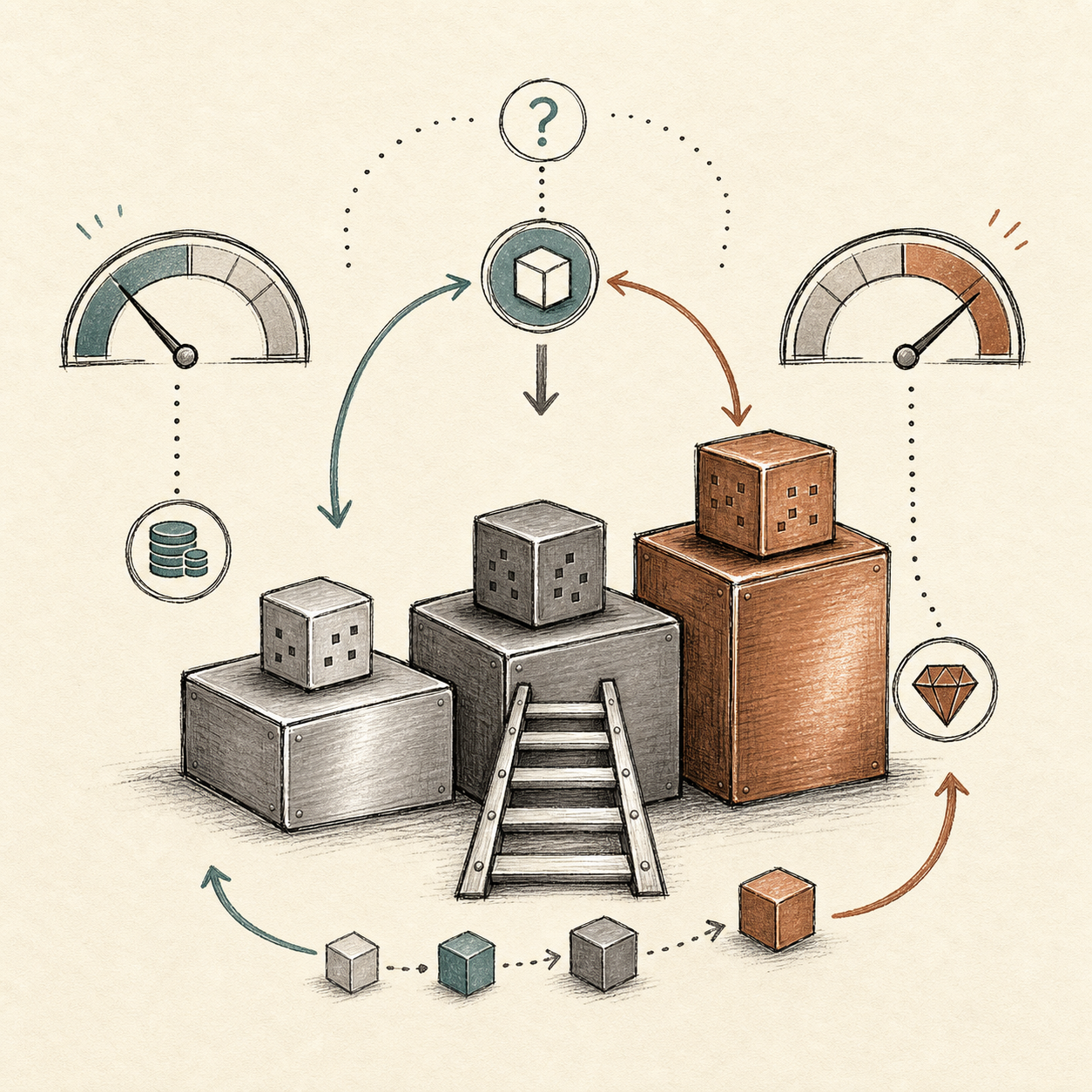
Model selection is a business tradeoff, not a leaderboard exercise. Frontier models can be worth the premium when the task is complex or failure is expensive. Balanced models often win for repeatable production workflows. Budget models are useful when the task is narrow, verifiable, and high-volume. The right tier is the cheapest model that clears the quality bar with acceptable review effort.
Frontier models: pay for judgment
Frontier models are most valuable when the task requires reasoning, synthesis, coding skill, long-context understanding, or handling messy instructions. They can also reduce hidden cost by lowering retries and review time. If a stronger model turns a two-hour human task into a ten-minute review, the higher unit price may be easy to justify.
Balanced models: the production default
Balanced models are often the sensible default for support triage, summarization, extraction, enrichment, meeting notes, and internal assistants. These tasks still need good output, but they usually have a clearer shape than open-ended reasoning. If you can define a rubric and sample outputs, balanced models are worth testing early.
Budget models: route and scale
Budget models shine when the work is simple and frequent: classify a ticket, detect a language, choose a route, extract a small field, rewrite a short sentence, or decide whether a request needs escalation. They are also useful as a first pass before a stronger model handles the hard cases.
Use escalation instead of one-size-fits-all
Many teams get the best economics by routing. Use a cheaper model first, escalate uncertain or high-value cases, and measure how often escalation happens. This approach can preserve quality while keeping average cost low.
In the pricing chart, look for the lowest monthly cost at the quality band that is good enough for the workflow. Then run a real sample set before rolling it out.
References and fact checks
- OpenAI API pricing - illustrates how model families and capabilities map to different unit costs
- Anthropic Claude API pricing - shows tiered model pricing and context/cache-related units
- Google Gemini API pricing - shows model-specific pricing and different billing units across capabilities
How to do this in AICC
Turn the article into an answer you can use
Use AICC to move from abstract model rankings to a tier decision based on your own workload, quality threshold, and monthly budget.
- 1
Start with the Pricing chart
Open the Pricing map and look at models by quality tier, provider, and monthly estimate. Do not start by sorting only on unit price; first identify the models that are plausible for the task.
- 2
Build a shortlist across tiers
Select one frontier, one balanced, and one budget option where possible. Include the provider and model names you would realistically be allowed to use.
- 3
Run the shortlist through Compare
Open the Comparison tool and enter the expected monthly input and output volumes. This shows whether the cheaper tier is still cheaper once the real workload shape is applied.
- 4
Use ROI to value quality differences
If the stronger model reduces review time or retries, enter that time saved in the ROI calculator. A higher monthly bill can still win if it saves enough human effort.
What you should have at the end
You should end with a tier recommendation: default model, escalation model, expected monthly cost, and the quality or review-time reason behind the choice.
Frequently asked questions
When is it worth paying for a frontier model instead of a cheaper one?
When the task is ambiguous, high-value, or failure-sensitive — a stronger model can cut review time and retries enough to justify the higher unit price.
What kind of tasks are a good fit for budget models?
Simple, frequent, narrow tasks like classification, language detection, routing, or short extractions — they're also useful as a first pass before escalating hard cases to a stronger model.
What's a practical way to control cost without sacrificing quality?
Route requests: use a cheaper model by default, escalate uncertain or high-value cases to a stronger model, and measure how often escalation actually happens.